
Reform of the FIFA Regulations on the Status and Transfer of Players (RSTP): what changes for transfers from 1 January 2027
The new FIFA RSTP comes into force on 1 January 2027: compensation for breach, liability of the new club and a share paid to the player. Our analysis.
The new FIFA RSTP comes into force on 1 January 2027: compensation for breach, liability of the new club and a share paid to the player. Our analysis.
- From the Diarra shock to the new RSTP
- 1. Why a reform? The shockwave of the Diarra judgment
- 2. A reform of method: the RSTP becomes an agreement between social partners
- 3. Amendment of Article 17 of the RSTP on compensation for breach without just cause
- 3.1 Before
- 3.2 After
- 4. The new club and inducement: evidence at the heart of the game
-
- FIFA transfers: what changes on 1 January 2027
- 5. Article 21bis: the player receives a share of their transfer
- 6. Other developments to be aware of
- 7. Entry into force and transitional provisions: mind the timetable
- 8. What this means in practice
- 9. Frequently asked questions
- Conclusion
-
On 10 June 2026, the Bureau of the FIFA Council adopted a fully revised version of the Regulations on the Status and Transfer of Players (RSTP). Presented as the most significant reform of the transfer system since 2001, it will come into force on 1 January 2027. Born of the Diarra judgment and negotiated with players' unions, clubs and leagues, it reshapes compensation for breach, the liability of the new club and the player's place in their own transfer. Here, in plain terms, is what changes.
From the Diarra shock to the new RSTP
Four key dates in the reform of the FIFA transfer system.
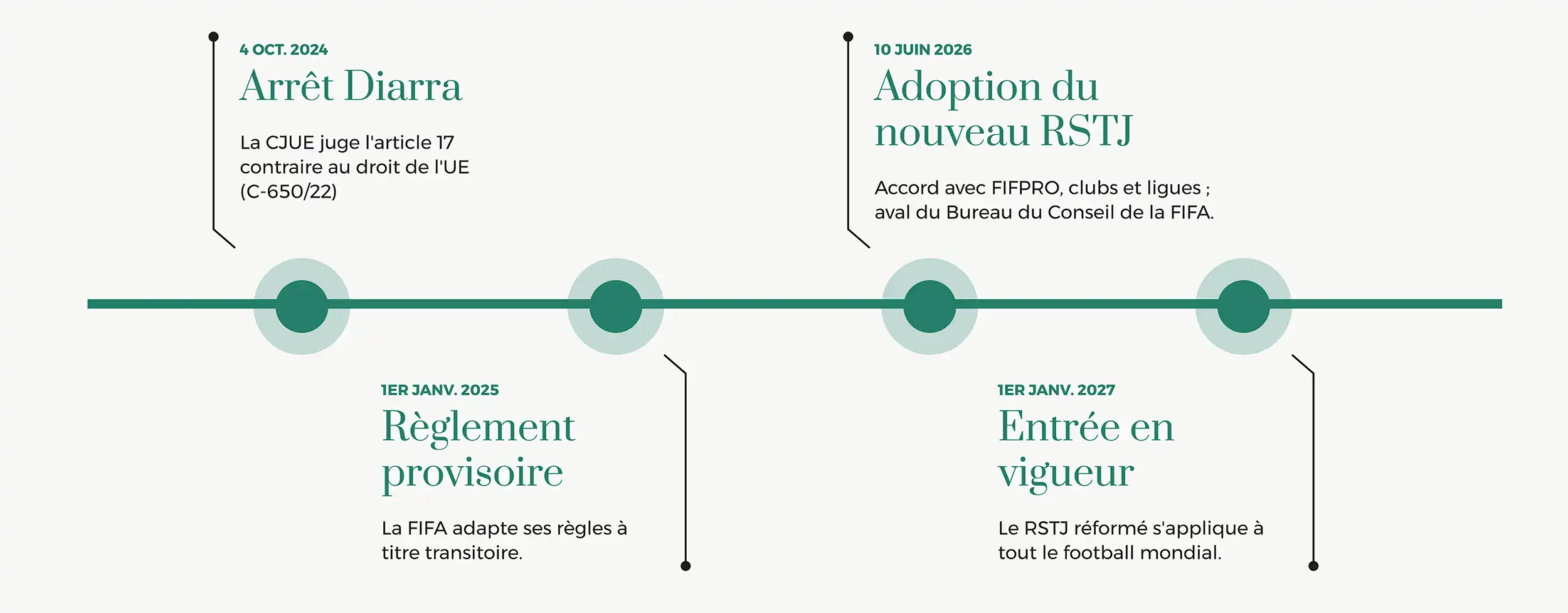
Timeline: from the Diarra judgment to the entry into force of the new RSTP
1. Why a reform? The shockwave of the Diarra judgment
On 4 October 2024, the Court of Justice of the European Union (CJEU) held, in FIFA v BZ, known as the Diarra judgment (C-650/22, full text in French on Curia), that several pillars of the RSTP were contrary to EU law, having regard to the free movement of workers (Article 45 TFEU) and competition law (Article 101 TFEU).
Three mechanisms were particularly targeted:
- the calculation of compensation for breach, held to be unpredictable and potentially punitive;
- the quasi-automatic presumption that the new club had induced the player to terminate, coupled with joint and several liability and sporting sanctions;
- the possibility of blocking the issue of the international transfer certificate (ITC) in the event of a dispute.
FIFA first adopted an interim framework on 1 January 2025, which in particular removed the automatic presumption of inducement, and then opened a dialogue with all stakeholders, which led to the text approved by the Bureau of the Council on 10 June 2026 (official FIFA press release).
2. A reform of method: the RSTP becomes an agreement between social partners
The first innovation lies less in the content than in the way the rule is made.
The new Article 1 states that the RSTP reflects a joint agreement between the employees' representatives, i.e. the players and their unions, and those of the employers, i.e. the clubs and leagues.
With the exception of Annexe 1, FIFA will no longer be able to amend the regulations without the agreement of the social partners, within a Global Social Dialogue Platform.
The stated ambition is to make the RSTP the first international collective labour agreement in sport.
In return, FIFPRO and its members agreed to withdraw all proceedings brought against FIFA concerning the transfer system.
This enhanced legitimacy does not, however, put an end to legal scrutiny.
After Diarra, the origin of a rule matters, but so does its concrete effect: each mechanism will still have to pass the EU law proportionality test.
3. Amendment of Article 17 of the RSTP on compensation for breach without just cause
Before going into the detail of the reform, a reminder is needed of the very concept of compensation for breach without just cause.
The contract between a club and a professional player is concluded for a fixed term, and contractual stability is the cornerstone of the RSTP.
A termination without just cause occurs where one party, the player or the club, unilaterally ends the contract before its expiry, without a legally recognised reason.
Just cause means a serious reason justifying termination, such as a serious breach by the other party; in its absence, the termination is said to be without just cause.
The regulations also recognise sporting just cause, available to a player who has taken part in only a small proportion of their club's official matches during a season (Article 15 of the RSTP).
The party terminating without just cause must then pay the other party compensation, provided for in Article 17 of the RSTP.
This compensation is not the same as a transfer fee: it is intended to make good the loss resulting from the early termination of the contract.
It is precisely this mechanism, long unpredictable and at the heart of the Diarra judgment, that the reform now regulates.
3.1 Before
Under the regime preceding the Diarra judgment, the compensation due in the event of termination without just cause was calculated on the basis of open-ended criteria: residual value of the contract, amortised fees and expenses, specificity of sport, protected period.
The result, often high, was difficult to predict and sometimes perceived as a penalty deterring any mobility.
The interim framework of 1 January 2025 had already begun to correct these excesses, pending a negotiated overhaul.
3.2 After
The new Article 17 sets up a clearer compensation system.
First, it enshrines agreed compensation: the parties may set in advance, in the contract, the amount due in the event of termination, in the manner of a buy-out clause (clause libératoire).
The FIFA Football Tribunal (Tribunal du Football) may reduce this amount only if it is excessively high, or disregard it only if it is manifestly inequitable.
For agreed compensation due to a player, Article 17(1)(c) refers to annual fixed remuneration of up to USD 150,000.
In the absence of agreed compensation, the injured party is entitled to full compensation for its loss, under separate heads of loss.
For the player, the assessment may include the residual value of the terminated contract and any additional loss.
For the club, it may include the value of the player's services, the lost transfer fee, the lost transfer value, replacement costs and other losses.
The residual value of the contract now constitutes the floor for compensation, below which only exceptional circumstances allow it to fall.
Finally, just cause is clarified: it means any situation in which a party cannot reasonably and in good faith be expected to continue the contractual relationship.
The parties are also required to cooperate in good faith in establishing the facts.
Focus on France: “agreed compensation” put to the test of the prohibition of buy-out clauses
By enshrining agreed compensation, the new Article 17 comes close to the buy-out clause, the Spanish-style mechanism allowing a player to leave their club by paying a sum fixed in advance.
French law, however, does not allow it.
Transposing the FIFA rule into a contract governed by French law therefore raises a real difficulty that no club or agent can ignore.
A fixed-term contract, with restricted termination and of public policy
The professional player's contract is a fixed-term contract, governed by the French Labour Code and by the Charte du football professionnel (Professional Football Charter), which has the status of a collective agreement.
Early termination is possible only in limited cases: agreement of the parties, serious misconduct, force majeure, established unfitness for work, or hiring of the employee on a permanent contract (Article L.1243-1 of the French Labour Code).
These provisions are matters of public policy (d'ordre public): the parties cannot derogate from them by means of a clause providing for termination against payment of agreed compensation.
Outside these cases, a player who terminates is liable for damages corresponding to the loss suffered by the club (Article L.1243-3 of the Labour Code).
The French logic is therefore the reverse of the buy-out: it is not the player who buys their freedom, it is the court that compensates a loss.
An express prohibition in professional football
This prohibition is not merely theoretical.
The regulations of the Ligue de Football Professionnel (LFP) expressly prohibit the buy-out clause, understood as a clause allowing either party to terminate the contractual relationship early in return for compensation (Article 202 of the LFP administrative regulations).
Such a clause, included in an approved contract, is thus deprived of effect.
Requalification as a penalty clause
Before a French court, the sum fixed in advance will not be analysed as a buy-out clause, but as a penalty clause (clause pénale), or even as a withdrawal clause (clause de dédit).
Article 1231-5 of the French Civil Code (Code civil) gives the court a moderating power that is a matter of public policy: it may reduce a manifestly excessive penalty, or increase it if it is derisory, and the parties cannot deprive it of this power.
This revisability precisely neutralises the effect sought by FIFA, whose Football Tribunal may reduce agreed compensation only if it is excessively high.
The supposedly intangible nature of the sum thus collides head-on with the power of the French court.
A conflict of norms and jurisdictions
The RSTP is a private set of regulations, applicable to clubs and players through their affiliation to FIFA.
But the mandatory rules of employment law and the Charte du football professionnel fall within social public policy (ordre public social), from which a federation rule cannot derogate.
A player or a club may bring the dispute before the Employment Tribunal (conseil de prud'hommes), whereas FIFA intends to reserve it for its Football Tribunal.
The Diarra judgment made the point for EU law: the negotiated origin of a rule does not exempt it from proportionality review.
The same requirement applies, domestically, with regard to French public policy.
In practice
Agreed compensation is not unusable in France, but it cannot have the effect of a buy-out there.
It must be drafted as a penalty clause compatible with domestic law: a reasonable and justifiable amount, consistent with the Charter, and accepting the possible moderating intervention of the court.
It is better to design the clause with its revisability built in from the outset than to bet on an illusory intangibility.
The whole challenge for contracts signed from 2027 onwards will be to reconcile the predictability sought by FIFA with French public policy.
4. The new club and inducement: evidence at the heart of the game
This is one of the major contributions of the reform, and the most direct response to the Diarra judgment.
Under the regime preceding the Diarra judgment, a club signing a player who had terminated their contract was presumed to have induced them to do so, which almost automatically triggered its joint and several liability for the compensation, and even sporting sanctions.
The interim framework of 1 January 2025 had already removed this automatic presumption and required inducement to be established.
The new RSTP consolidates this approach while clarifying it: the new club is jointly and severally liable only if it is established, on the balance of probabilities, that it actually induced the player to terminate.
It does, however, reintroduce a presumption of inducement, but in a single, strictly defined case: if the player signs a new contract within 45 days of the termination.
The club must then demonstrate, to the comfortable satisfaction of the FIFA Football Tribunal, that it did not induce the termination (Article 17.11 of the RSTP, official French version).
In practice, evidence becomes central: any prudent club will document the chronology of contacts, the legal basis relied on for the termination and the due diligence carried out before signing.
FIFA transfers: what changes on 1 January 2027
The main changes to the Regulations on the Status and Transfer of Players
Comparison: the main changes to the RSTP on 1 January 2027
5. Article 21bis: the player receives a share of their transfer
The new Article 21bis creates a direct economic right for the lowest-paid players.
On a permanent international transfer, a player whose annual fixed remuneration with the releasing club is below 150,000 euros must, in principle, receive 5% of the fixed transfer fee actually received by that club.
This payment is not the same as the solidarity contribution under Article 21, which benefits training clubs: Article 21bis is paid directly to the transferred player.
Example: for a transfer with a fixed fee of one million euros, involving a player whose annual fixed remuneration with the releasing club is below 150,000 euros, the releasing club must pay approximately 50,000 euros to the player.
Where the fee is paid in instalments, the player's share follows the payment schedule.
It is subject to tax and mandatory deductions, and allows only limited waivers, subject to national law and applicable collective agreements.
A point of caution for practitioners: the thresholds are not worded identically.
Agreed compensation due to the player (Article 17(1)(c)) refers to annual fixed remuneration expressed in dollars (USD 150,000), whereas Article 21bis is expressed in euros (EUR 150,000).
Annual fixed remuneration is moreover assessed pro rata, with signing-on and loyalty bonuses spread over the year concerned.
6. Other developments to be aware of
- A recalibrated protected period, which adjusts contractual stability according to the age of the contract.
- Express recognition of abusive exclusion: deregistration, exclusion from training, deprivation of housing, retention of passport or payment defaults may now be sanctioned and constitute grounds for termination with just cause.
- Penalties of up to six months' salary in certain cases.
- A standard interest rate of 8% in specified payment disputes.
- Revised contracts for certain players under the age of 18.
- Clarified international transfer certificate procedures, so that a dispute alone no longer blocks the issue of the certificate and the registration of the player.
- Consequential amendments to the FIFA Disciplinary Code, the Governance Regulations and the procedural rules of the Football Tribunal.
7. Entry into force and transitional provisions: mind the timetable
As a general rule, the new RSTP applies to events giving rise to disputes occurring on or after 1 January 2027.
Two provisions, however, follow a more restrictive rule: agreed compensation under Article 17(1) and the player's share under Article 21bis apply only to contracts concluded on or after the entry into force of the reform.
As a result, different regimes will coexist during the first few years.
A termination occurring in 2027 may therefore fall under most of the new Article 17, while an agreed compensation clause in a contract signed in 2026 will remain subject to the old regime.
Likewise, a player transferred after 1 January 2027 will benefit from Article 21bis only if their contract with the releasing club was concluded after that date.
The precise dating of contracts, terminations, transfers and payment deadlines will therefore become a decisive issue.
8. What this means in practice
For clubs, it is time to review contract templates: should agreed compensation or a buy-out clause be provided for, and for what amount?
Before signing a player who has terminated their contract, genuine due diligence is essential, with the chronology and evidence preserved.
For players and their advisers, the challenge is to secure buy-out clauses, anticipate Article 21bis and document any abusive exclusion.
In this new system, the best legal argument will still count, but the best evidence file will often be decisive.
9. Frequently asked questions
When does the RSTP reform come into force?
The new RSTP was adopted on 10 June 2026 and comes into force on 1 January 2027.
What is the Diarra judgment?
It is the CJEU decision of 4 October 2024 (FIFA v BZ, C-650/22) which held Article 17 of the RSTP and associated mechanisms to be contrary to EU law. It is the origin of the reform.
What is agreed compensation?
It is the possibility for the club and the player to set in advance, in the contract, the amount due in the event of termination, in the manner of a buy-out clause. The Football Tribunal may reduce it only if it is excessive, or disregard it only if it is manifestly inequitable.
Is a buy-out clause valid under French law?
No, not as a buy-out. The rules on termination of fixed-term contracts are matters of public policy and the LFP regulations expressly prohibit buy-out clauses. A sum fixed in advance is requalified as a penalty clause, which the court may revise under Article 1231-5 of the Civil Code.
Is the new club always liable for the compensation?
No. It is liable only if its inducement to terminate is established. Inducement is presumed only if the player signs within 45 days of the termination, in which case the club may prove the contrary to the comfortable satisfaction of the Football Tribunal.
What does Article 21bis provide for the player?
On a permanent international transfer, a player earning less than 150,000 euros a year receives 5% of the fixed transfer fee received by their club, in addition to the solidarity contribution paid to training clubs.
Conclusion
The RSTP reform marks a turning point: greater predictability in compensation for breach, liability of the new club refocused on proof of inducement, economic recognition of the player and rule-making based on social dialogue.
It also raises the standard expected of everyone, clubs, players and agents alike, in drafting contracts and preserving evidence.
In France, the interplay with social public policy and the prohibition of buy-out clauses will call for particular care in drafting agreed compensation clauses.
Fellous Avocats assists clubs, players and agents in anticipating these new rules, from drafting clauses to handling disputes before the FIFA Football Tribunal.
Sources
CJEU, 4 October 2024, FIFA v BZ (Diarra), Case C-650/22, EU:C:2024:824: full text in French on Curia; EUR-Lex record.
FIFA, press release of 10 June 2026, “Bureau of the Council approves new regulatory framework for the global football transfer system”: inside.fifa.com.
FIFA, official “Transfer System 2027” page: inside.fifa.com/transfer-system/transfer-system-2027.
FIFA, RSTP, January 2027 edition: downloadable from the official Rules and regulations page (inside.fifa.com), as the PDF is not yet available at a stable direct URL.
FIFA, RSTP, July 2025 edition (French version, PDF): digitalhub.fifa.com.
FIFPRO and UNFP, press release of 10 June 2026 (French version): unfp.org.
French Labour Code, Articles L.1243-1 and L.1243-3; Civil Code, Article 1231-5 (Légifrance).
LFP administrative regulations, Article 202; Charte du football professionnel.
Your contact

Laurent Fellous
Founding lawyer of Fellous Avocats. The firm advises businesses, their executives and sports stakeholders, in both advisory and litigation matters.